


- Yachts For Sale
- New Yachts
- Buying & Selling
- Yacht Brokers
- Boat Shows
- Yachting


Search All Yachts
Search All Yachts
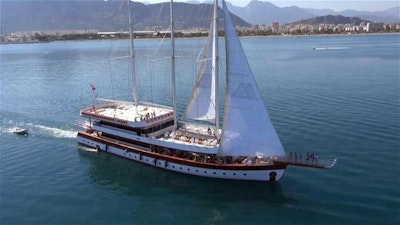
138' Custom 2009
$ 2,500,000
Batumi, Georgia

136' Custom 2006
$ 639,650
Crete, Greece

118' Custom 36m Gulet 2009
$ 1,744,500
Kos, Greece

116' Custom 2012
$ 2,558,600
Athens, Greece

114' Custom 2023
$ 1,511,900
Bodrum, Turkey

104' Gulet Gulet 2007
$ 1,628,200
Gocek, Turkey

98' Custom Gulet 2005
$ 1,337,450
GOCEK, Turkey

98' Custom 2000
$ 1,163,000
MUGLA, Turkey

88' Custom 2003
$ 1,570,050
MUGLA, Turkey

78' Custom 2009
$ 895,510
MUGLA, Turkey

78' Custom 1995
$ 674,540
Mugla, Turkey

75' Custom 1990
$ 465,200
MUGLA, Turkey
Hop aboard a present day motor sailer and you wouldn’t know it, but this genre, over time, has truly evolved. Rewind back to the late 1960s and, one might remember how fiberglass construction began refashioning the face of boat manufacturing and design. Motor sailers were almost always long keeled, heavy displacement vessels with humble sail plans. As time progressed, builders added size to the rigs for upgraded performance. In addition, hull shapes improved to offer superior handling characteristics while sailing.
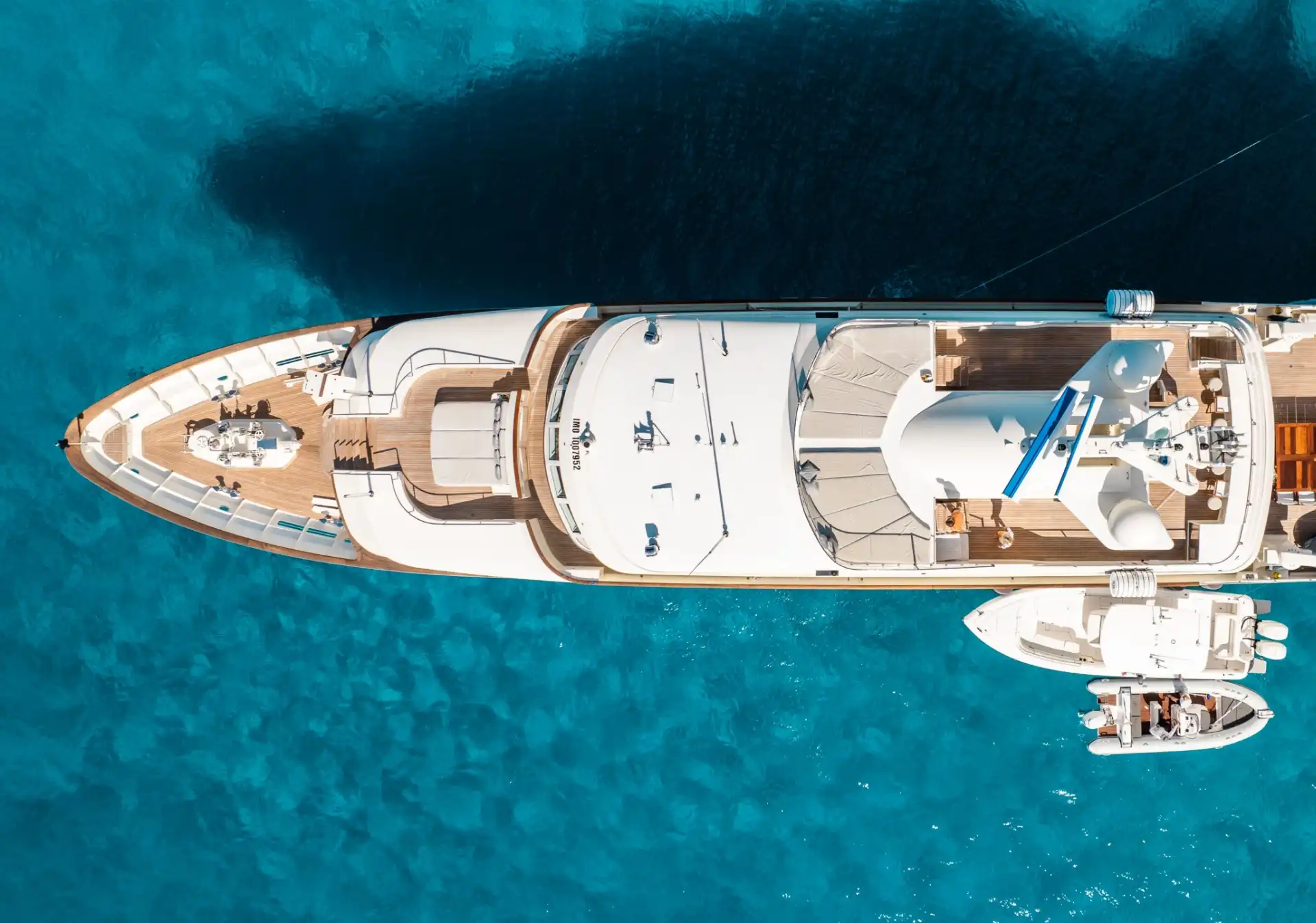
The motor sailer is known for its devoted followers —thanks to this very evolution too. They especially love the vessel’s sheltered steering position with its 360 degree view. Let’s not forget the lure of a big engine that powers the boat to get moving quicker than the sails.
When narrowing it down to a special style motor sailer, it’s important to review priorities as the majority of the time when designing this type boat, you’ll find it calls for a plethora of compromises. So get your priorities in order…then… select the model that matches all of your leading criteria.
Let’s start with recommending a ketch rig where the easy to handle mizzen offers a noticeable stabilizing effect —when under power— without having to set the mainsail. One is able to even sail it with just mizzen and headsail in strong winds —another point in the easy handling category. And, when anchored, the mizzen can be kept set, and the boat lying head to wind, greatly rising the comfort bar aboard along with prohibiting the boat from sheering around in high wind weather.
Next we have the shift from the traditional long keels, that offered great directional stability at sea, but were less responsive when under sail and were a challenge to maneuver in the harbour, to select modern designs having lifting keels, allowing for access to a far-reaching range of harbours, or bilge keels, which - at low tide - grants the boat the ability to dry out upright.
The motor sailer wheelhouse, is a great option, making steering a breeze in bad weather. For those night cruises, a small wheelhouses - separate from the boat’s accommodations, allows you the advantage of the area to be kept dark for keeping an effective lookout. Another advantage is that when moored, an owner will appreciate it’s value of a tremendous 360 degree view around the boat. We recommend selecting a model that offers a spacious seating area for a deck salon opportunity.
Why are motor sailing yachts becoming more popular these days? Mostly… because it just makes sense. And in addition to the sheer fun of sailing, motor sailer enthusiasts will brag about it’s propulsion backup and efficiency, roll reduction, not to mention the amazing synergy of engaging two simultaneous modes of propulsion! One may even be thrilled to save the cost of a get-home or second main engine and shift the funds into investing in a good sailing rig.
The ideal motor-sailer should be 100% sailing vessel, and 100% power vessel. Mainly motoring, then turn on the fueled engine. Of course, the same holds true for those looking to utilize her primarily as a sailing yacht. The vessel’s design is known to be given a higher bow for those days when powering into the weather is the choice. Another tip, is to ensure your choice offers sufficient beam to provide for good sail carrying power, but not too much more.
The owner who wishes to focus more on the powering portion of this boat will look for a "powerboat-type" layout, but don’t forget a modest "get-home" sail rig will be well loved too. The combo offers the guests the lull a good sail brings on providing the wind cooperates. There’s nothing like the peace of mind knowing the guests will never have the disappointment of a mechanical failure and their voyage will always be safe at sea.
Let’s talk performance with these beauties… A magnificent synergy between motoring and sailing gives its owner something that would never be achieved exclusively with power OR solely sail. One will be surprised with the speed boost that’s embraced by this beautiful marriage of the two. Start out on a motor-sailing voyage and expect a mere 3 knots of fuel to get you a whopping 7 to 10 knots of boat speed!
This can only be said for those days that mother nature sends the right winds to allow for this type sailing cruise. On that perfect day of wind, when looking for zero cost in fuel, and less of a rush to get to your destination of choice, set sail and leave the motors off! You’ll want to use your savings on those tropical drinks and fancy fish dinner at the exclusive island hot spot anyways! So start those engines and get the sail rigged right and you’re off for a journey that is sweet in many ways!